


Our dear Bruno has passed away.
A great lover of the arts and a talented photographer, he had set up the photography workshops at the Maison de la Culture and wrote music and culture columns for the regional press.
He was one of our most loyal listeners. A man of great culture and rare sensitivity, he was able to appreciate the repertoire and performers of the string quartet at their true value.
For two decades, he photographed the concerts of Les Voix Intimes. We are left with his magnificent photographs of the Hagen, Talich, Tokyo, and many other quartets.
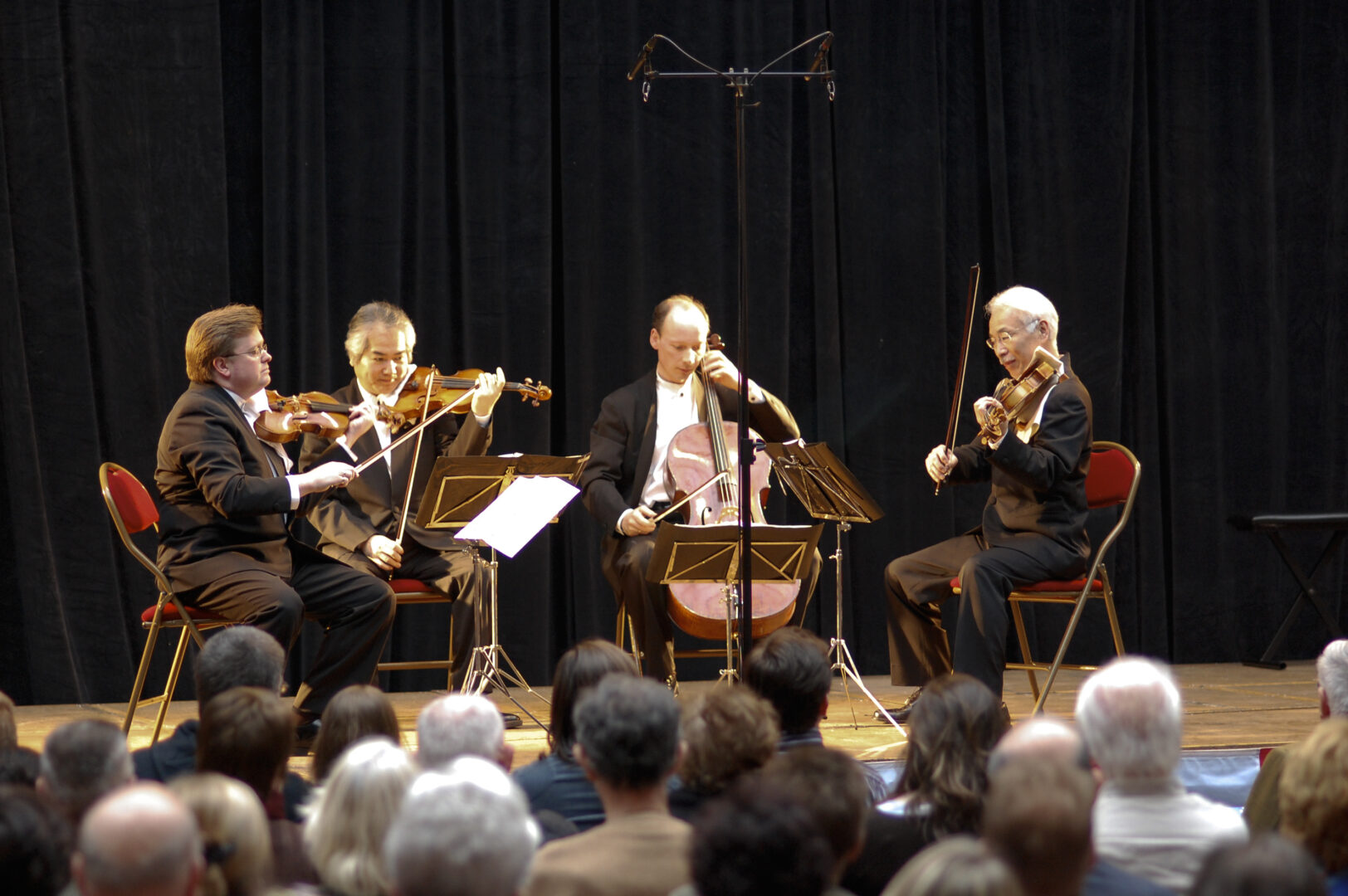
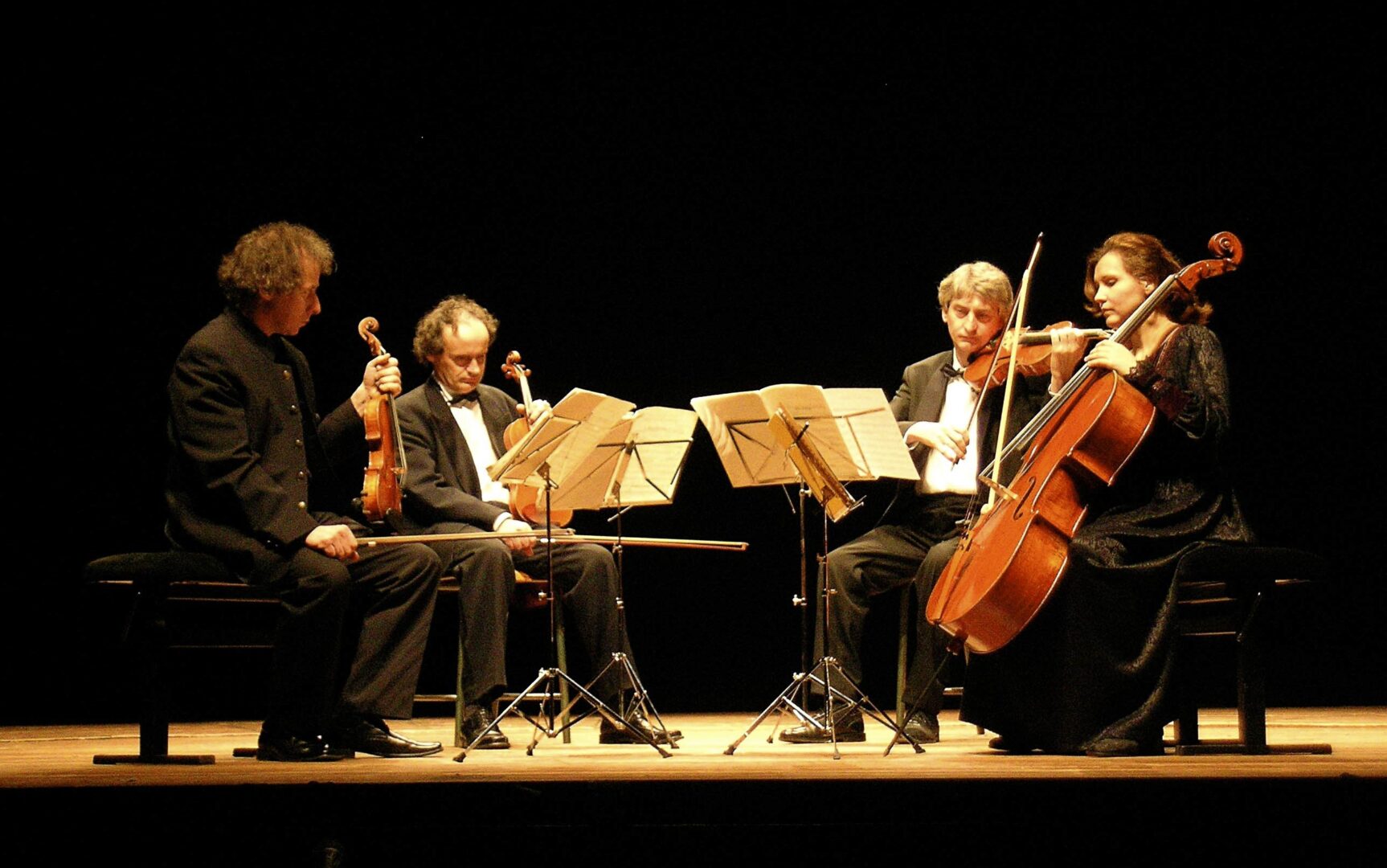
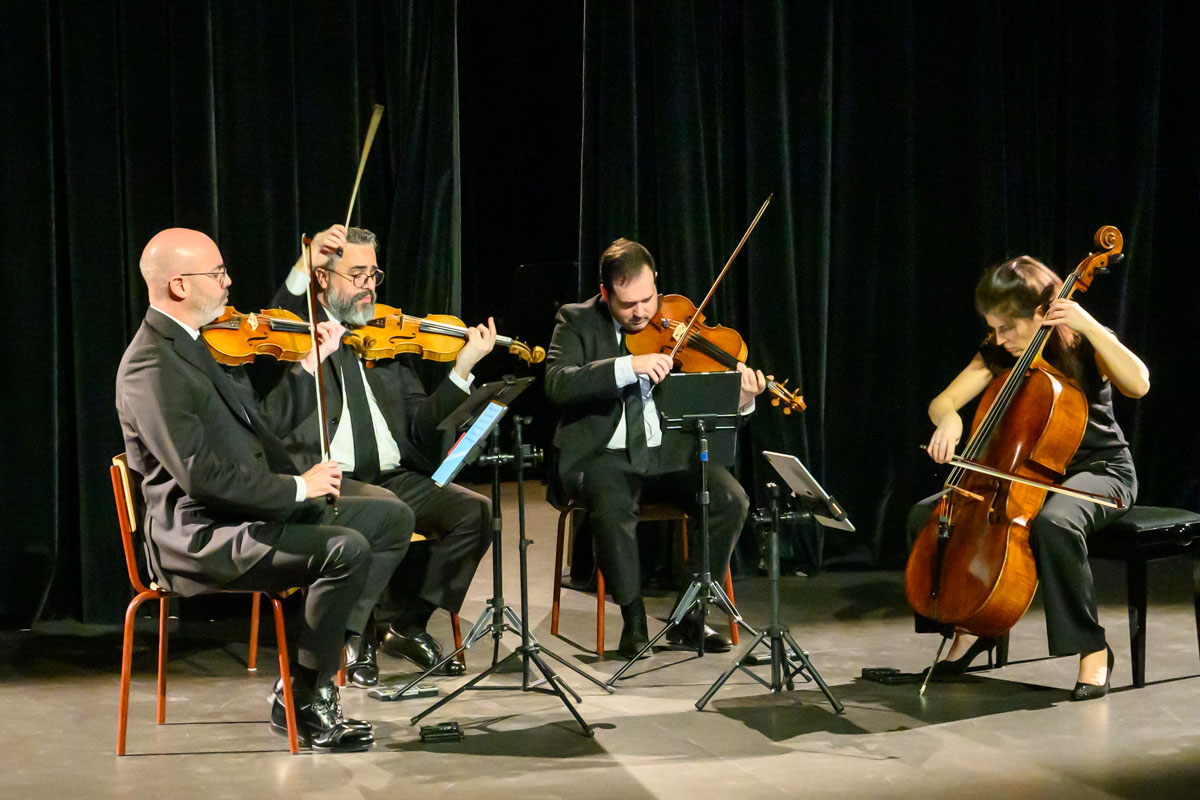
In 2013, he contributed an article to our anniversary book Voces Intimae. We reproduce it below, with the permission of the publisher P. Peeters.
Farewell, dear friend, and thank you.
The Voix Intimes will miss you terribly!
This is not for you! It is for the times to come.
Beethoven, on the quartets of Opus 59.
Tradition teaches us that perfection is not of this world. However, when listening to certain musical works, particularly some string quartets, one might legitimately wonder whether it is not within earshot.
It is on this assumption that the monuments of Beethoven and Bartók can lead to the creation of a kind of modern mythology, which is reinforced and magnified in those who do not play an instrument, insofar as their fascination is based on the sometimes wild, or at least random, encounter between the most direct emotion and the most sophisticated intelligence. Hearing and seeing a Beethoven quartet for the first time, for example, is an initiatory process that awakens a sense of belonging to a select group, marked by a unique experience. This approach could be that of a young, uninitiated but passionate and totally sincere music lover. It would be the journey of a naive ear driven by a simple mixture of desire and curiosity. This "wild" apprehension of the musical phenomenon excludes, in the assumed ignorance of scholarship and musicological precepts, any awareness of Haydn's founding contributions, any intuition of Mozartian perfection. Passion blinds, or rather deafens in this case, and at least in the unconscious, Beethoven's construction appears unique, as if it came out of an unimaginable void.
However, things are not quite so simple: naivety is not innocence. Emotions overlap and eventually settle to form the substrate that will feed this famous desire. In this sense, the artistic experience, but more particularly the musical experience, is very close to the experience of love and, more generally, to any passionate experience. Desire is supposed to generate pleasure, and pleasure brings us back to desire. Thus, what is fleeting, or at least temporary—the duration of a concert or a record—leads to an illusion of eternity through repetition. And this illusion is perhaps eternity itself within the reach of a human life.
My first encounter with the quartet was sealed half a century ago by the classic double album featuring Debussy and Ravel. With this discovery on record, that fabulous vinyl that opened so many doors, the "fourth dimension" of listening—the intimate, only adequate way—still eluded me, for reasons both acoustic (the constraints of the record player) and musical (the endurance of an almost frenetic relationship with large orchestral constructions). Ravel's Quartet stood out, but as one work among others, and yet not quite the same.
In this quest for a different kind of music, less spectacular but more subtle, one essential element was missing: concerts. The Jeunesses Musicales concerts in Brussels, enhanced by the presence of Messiaen or Berio, or conducted by Cluytens, added extra soul to what was then becoming a major event. But the opportunity to put my senses to the test of a real chamber music performance would come later, in the form of a Beethoven quartet—probably the Fourth. I experienced the concert as an event. It was in its wake that I would listen to Death and the Maiden and the romantic exhumation of a certain "Unfinished Symphony." I wasn't ready for Schubert. But Beethoven imposed himself on me, soon leading me to build up a discography of his famous quartets.
Such beautiful and accurate things have been said and written about this exceptional ensemble that it would be futile, if not pretentious, to delve into musicological considerations here. I will therefore stick to the realm of emotions, comforted by the idea that, at the time, it was above all music in general that attracted me. Nevertheless, I would note that, by proceeding by analogy and comparison, it was inevitable that, after experiencing a mixture of pleasure and raw emotion upon discovering one or another of the great deaf composer's works, I would delve in a more "cerebral" direction. This direction led to a process of analysis that ultimately became comprehensive, with its accompanying readings and discussions.
Is there a quartet in Beethoven's oeuvre that first stirred my emotions and led to the rest? Paradoxically, the answer reveals itself by default, through the emergence of memory, imposing itself almost naturally after a period of reflection. My "favorite" quartet is the7th, the first of Opus 59.
This is a far cry from the fabulous13th and14th quartets, which will continue to inspire much discussion and emotion for centuries to come. No, this is a pleasant, accessible work with a relatively classical structure, despite a slow movement inthird position and a few unusual features. Who knows if, in terms of mood, the memory of that lady in the record department of a well-known store in Brussels, who sang the beginning of the first movement to me, reminding me of a fraternity to which I had hitherto felt alien, played a part – yes, there were people willing to hum a quartet movement as others would have sung a song by Piaf, Ferré... or Hallyday! Let's not look any further: this first movement, whose almost vital momentum is quite close to the spirit of the first movement of the Pastoral Symphony, is quite simply lyrical. And it is a joyful, dynamic lyricism that does you good and gives you the strength to face life.
The second movement is just as melodious, even if the tone is somewhat sarcastic, or at least doubtful. Beethoven's psychology is fully evident here in a sense of questioning, doubt, and contradiction expressed through alternating ascending and descending melodic lines. A touch of humor, and perhaps even intellectual irony, emerges from what heralds the duality expressed in the16th quartet: "Must it be? It must be" – the latter also incorporating a vague reference to the "Stream Scene" from the same6th Symphony. With Beethoven, everything fits together!
From psychological, the work becomes metaphysical, anticipating the dimension of his later opuses. But there is also a playful dimension, covering abysses of depth. This is the Beethoven of the Bagatelles, who throws a tantrum "over a lost penny," parodies himself in the Eroica Variations, and transforms a little waltz by Diabelli into a musical masterpiece.
And then, returning to the subject, there is the emergence of the cello in this quartet. Until then, it had bravely played its role of broadening the range and, in certain circumstances, it sometimes took center stage when the patron, a wealthy amateur, played it himself. With this quartet, the cello invests itself fully in the work. This detail, which is not really a detail at all, is revealed with varying degrees of acuity depending on the interpretation. Thus, the Quartetto italiano's interpretation, which is both elegant and harmonious, controls this almost centrifugal aspect very well. The music seems to be produced by a single instrument. Recently rediscovering the Vlach version – through Supraphon vinyl records, which are enhanced by a high-quality cartridge – I was surprised by the presence of the cello, which, through a dynamic of detachment and rapprochement, reflects a Beethoven who is both individualistic and fraternal.
I cannot praise this quartet without mentioning its Adagio, which sometimes takes us into the darkest recesses of the unconscious, and at other times offers an almost heavenly respite.
Finally, there is this accumulation of technical difficulties, so feared by musicians, but which should in no way obscure the formal game played by the composer. For everything is constructed with a concern for balance and harmony, while tensions develop that herald all the deconstructions to come. For Beethoven's modernity is present, but above all, it is Beethoven in his entirety as a creator who permeates the work. In a somewhat reductive formula, one could say that everything has been said, but that everything remains to be said. An apparent contradiction – but is it not the lot of every masterpiece to be both an end and a beginning?
Looking back, I must admit that my relationship with the quartet developed both in parallel with other aspects of music and as an extension of genres whose emotional capacity was waning. Beethoven's symphonies, even his concertos, appreciated through the lens of a new listening paradigm, no longer had the impact they once had. They had lost their ability to surprise.
To astonish? That would be the secret of music that always has surprises in store, new perceptions, tiny details to be revealed with each new experience. But then again, isn't the ultimate purpose of art to astonish, to surprise, to shake up certainties and, ultimately, to make the moment last?
The string quartet, by its very nature, with its ability to cover a wide range, as if it were a single instrument, is a machine for producing masterpieces. Some composers felt the need to expand the ensemble: Schubert and Schumann reached new heights of expression with their quintets; Brahms reinforced his inner journey with his two string sextets and his clarinet quintet. But these are exceptions, and it is highly likely that as long as there are composers, there will be new string quartets.
It is tempting to pause for a moment to consider symbolic and social aspects. The string quartet evokes both the idea of unity—the One—and multiplicity—the Others. It can be seen as a metaphor for an ideal society where each individual can choose, at any given moment, to share a common experience while retaining their free will. The "political" dimension of the quartet is obvious and, in this sense, contrasts with the functioning of the orchestra or the soloist. At a given moment, four artists decide to bring their often very strong personalities together, not to oppose each other, but to produce something greater than what they could achieve individually. The string quartet is a space of fraternity.
I cannot conclude these few thoughts inspired by personal experience without mentioning the visual pleasure of watching these artists give their very best. We are fortunate in Tournai to be able to experience these special moments, which are unique in the musical life of the region. The Festival des Voix Intimes opens the doors to the unfathomable and reveals, at each concert, the inner song that is within each of us.
B. Lestarquit