


From January 10 to 18, the Cité de la Musique ( Paris) hosted its twelfth Biennale de quatuors à cordes, a gathering of today's finest ensembles and enthusiasts of the genre.
Let us welcome the Ébène, Belcea, Hagen (soon to bid farewell to the stage), Casals, Arod, and Jerusalem quartets, not to mention the Pavel Haas Quartet and the Tana Quartet, who are expected to perform at the next Les Voix intimes Festival.
An international audition for young string quartets was organized alongside the event. A true showcase for conservatories and professional specialization programs, this day allowed the public and the artistic committee to discover no fewer than 10 young quartets selected from among some 50 candidates.
Given the relative brevity of each performance, it feels like watching the preliminary rounds of a string quartet competition, but without the rules of protocol or the set pieces.
Each group presents a free program lasting around 25 minutes, ranging from Haydn to Takemitsu, including some interesting rarities such as Jean Cras' quartet and Hans Gal's first quartet.
Saturday, January 17, 2026, 10 a.m. Amphitheater of the Cité de la Musique.
The Animato Kwartet opens the session. This Dutch ensemble won a special prize at the Joseph Joachim International Chamber Music Competition (2022) and first prize at the Irene Steels-Wilsing Foundation International Competition (2025). The musicians play standing up in front of their music stands and reveal great cohesion and a varied palette of sounds, whether in the magnificent introductory movement of Benjamin Britten's First Quartet or in the third movement of Béla Bartók's First Quartet.
The Cong Quartet's program is divided between excerpts from quartets by Debussy and Dvorák (the American) and two pieces of Asian music, one of which is essentially folk music and the other a free contemporary composition (Chen Gang and Adrian Wong).
With the Novo Quartet —which also plays standing up—we enter another sphere of interpretation. The ensemble's track record is impressive, having won top prizes at competitions in Geneva, Heidelberg, Nielsen, and Trondheim, and boasting no fewer than 70 concerts a year. A beautiful cohesion and balance of voices animates the musicians both in the two movements of Joseph Haydn's Quartet Opus 54 No. 2 and inthe convulsive Allegro non troppo of Dmitri Shostakovich's Third Quartet. The solos follow one another with great conviction and rigor. To conclude, NOVO chose an excerpt from Bedrich Smetana's quartet From My Life, in which the performers express all the Slavic nostalgia of a composer struck by deafness.
Next up is the Kairi Quartet, a Japanese ensemble based in Salzburg, performingthe openingAllegro from Haydn's Quartet Opus 74/1. The beautiful cohesion of the ensemble and the generous vigor of the first violin are immediately apparent. After a technically masterful performance of Landscape by their compatriot Tôru Takemitsu, the musicians conclude their recital with a few excerpts from Felix Mendelssohn's Quartet Opus 13. Here again, the ensemble is well-rehearsed, with a very wide range of intensities.
The morning session ends with the Våren Quartet, which brings together friends from Toulouse whose career as a quartet has been marked by distinctions (first prize in the FNAPEC competition, second prize in the Premio Giangrandi-Eggmann competition, and third prize in the Lyon International Chamber Music Competition). The first movement of Debussy's quartet is followed by the slow movement of Jean Cras's quartet, which is deeply moving (what could be more normal for a sailor at the helm of a torpedo boat during the First World War!). This is undoubtedly one of the unique features of this day: offering the audience works that large ensembles do not program, caught between the habits of an audience that is not very curious by nature and those of organizers who do not want to take any risks! The second violin takes the place of the first inthe Allegro molto capriccioso of Béla Bartók's Second Quartet, as is increasingly the case in a quartet democracy.
The day continues with a performance by the excellent Javus Quartett, a young ensemble based in Salzburg and trained by quartet players Lukas Hagen, Johannes Meissl, and Gregor Sigl. The quartet is currently studying in Vienna and Berlin while pursuing an already busy early career. The musicians have chosen to perform two movements from Haydn's Sunrise Quartet, Op. 74/4. The surprise comes with two magnificent movements from Quartet No. 1 by Hans Gál, a little-known Austrian composer who was forced to flee to Great Britain when the Nazis came to power. The richness of the modulations and the elaborate construction of this work deserve to be ranked alongside the quartets of Paul Hindemith, Karl Weigl and Alexander von Zemlinsky.
The name Arete Quartet is inspired by the Greek word for excellence...Indeed, this young South Korean quartet already has an exceptional track record: winner of the Prague Spring Competition, first prize at the Mozart Competition in Salzburg and the Lyon Chamber Music Competition, second prize at Banff and third prize at Bordeaux! After a few remarkable excerpts from Robert Schumann's Opus 41/1, which reveal a magnificent rapport and flawless precision, the musicians chose two movements from Leoš Janáček's Quartet No. 1, Sonata à Kreutzer, which they perform with great vigor and striking contrasts.
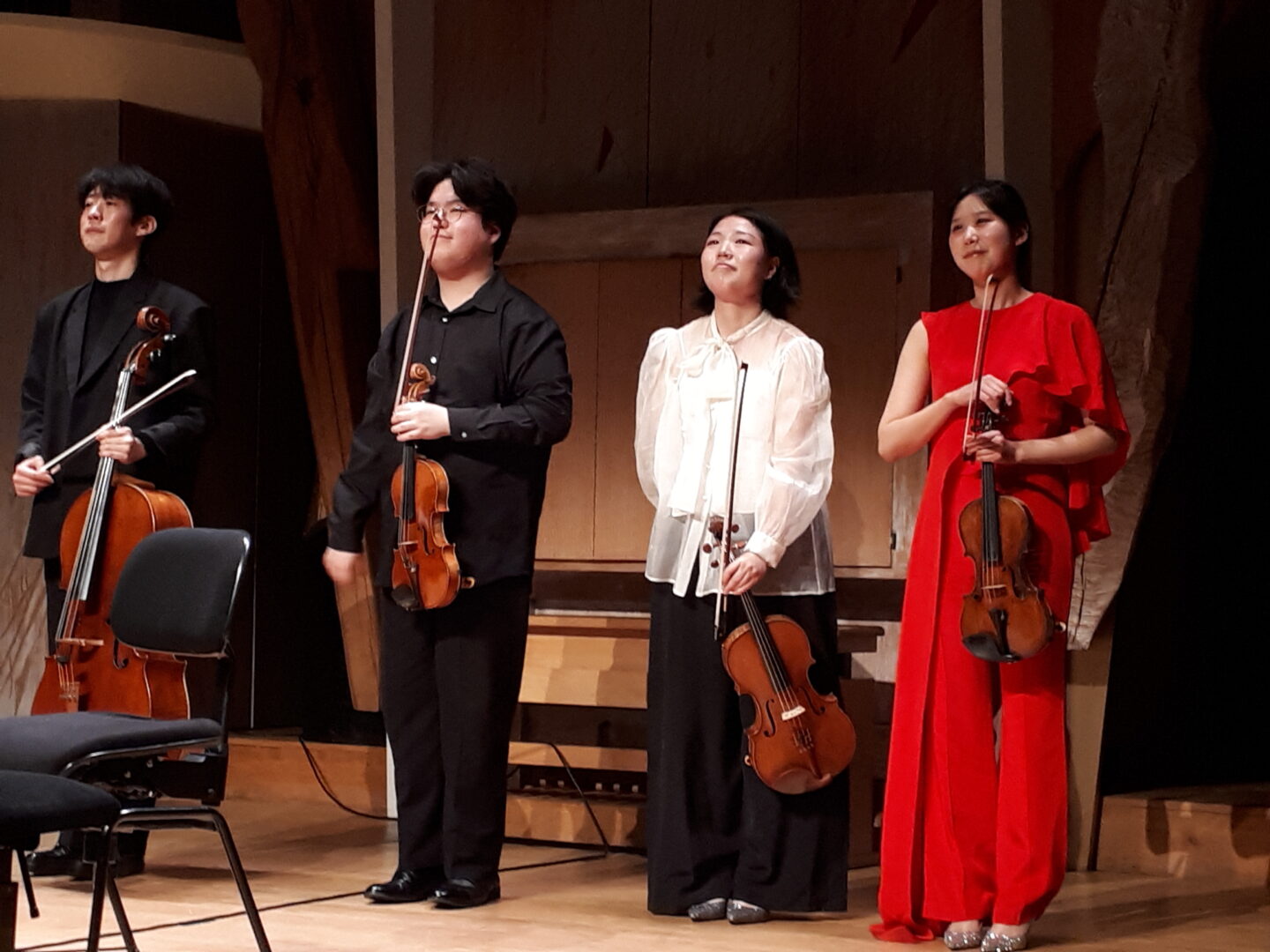
Almost all dressed in white, the members of the Turicum Quartet take to the stage with Haydn'sAllegro spirituoso from Opus 64/2, followed by two movements from Karol Szymanowski's first quartet. The quartet concludes its performance with three excerpts from Five Pieces for Quartet by Czech composer Erwin Schulhoff, including the famous Diabolical Tarantella.
The Quartett Hana studies with the Ébène Quartet, Günter Pichler, Eberhard Feltz, Oliver Wille (Kuss Quartet), Gerhard Schulz, and the Voce Quartet. It has since been accepted as an ensemble in residence at Proquartet for a period of two years. The violist plays in a Czech configuration, which positions the instrument on the outside right, facing the first violin. They have chosen two movements, one fast, from Dvorák's Opus 106, and the other slow, the famous Andante con moto from Schubert's Quartet No. 14, Death and the Maiden.
This exciting day of auditions ends with a remarkable performance by the Fibonacci Quartet, an ensemble formed at the Guildhall School of Music and Drama in London, which rotates the position of first violin! Winners of first prize and the audience prize at the Premio Paolo Borciani (2024), this cosmopolitan quartet (two English, one Belgian, and one Czech) already has a busy career and stands out from other ensembles with its personal arrangements of non-classical pieces, even borrowing from jazz and local folklore, while still drawing on the great repertoire. Today's program brings together a few Moravian folk songs arranged by the quartet and the complete second quartet, Lettres Intimes, by Leoš Janáček.
Dominique Huybrechts, artistic director of the Les Voix intimes quartet festival