


Seldom has a photograph offered such a striking encapsulation of the creative forces that shaped European music during the interwar period.
This historic document captures 14 of the most significant composers of the period: among them are Anton Webern (No. 12), Ethel Smith (No. 7), Paul Hindemith (No. 5), and Arthur Bliss (No. 4), who gathered in Salzburg in August 1922.
Most of them wrote a string quartet, and some wrote many more: in total, this small group composed no fewer than 70 quartets … a considerable number, reflecting the prominence of this form during the 1920s and 1930s (1).
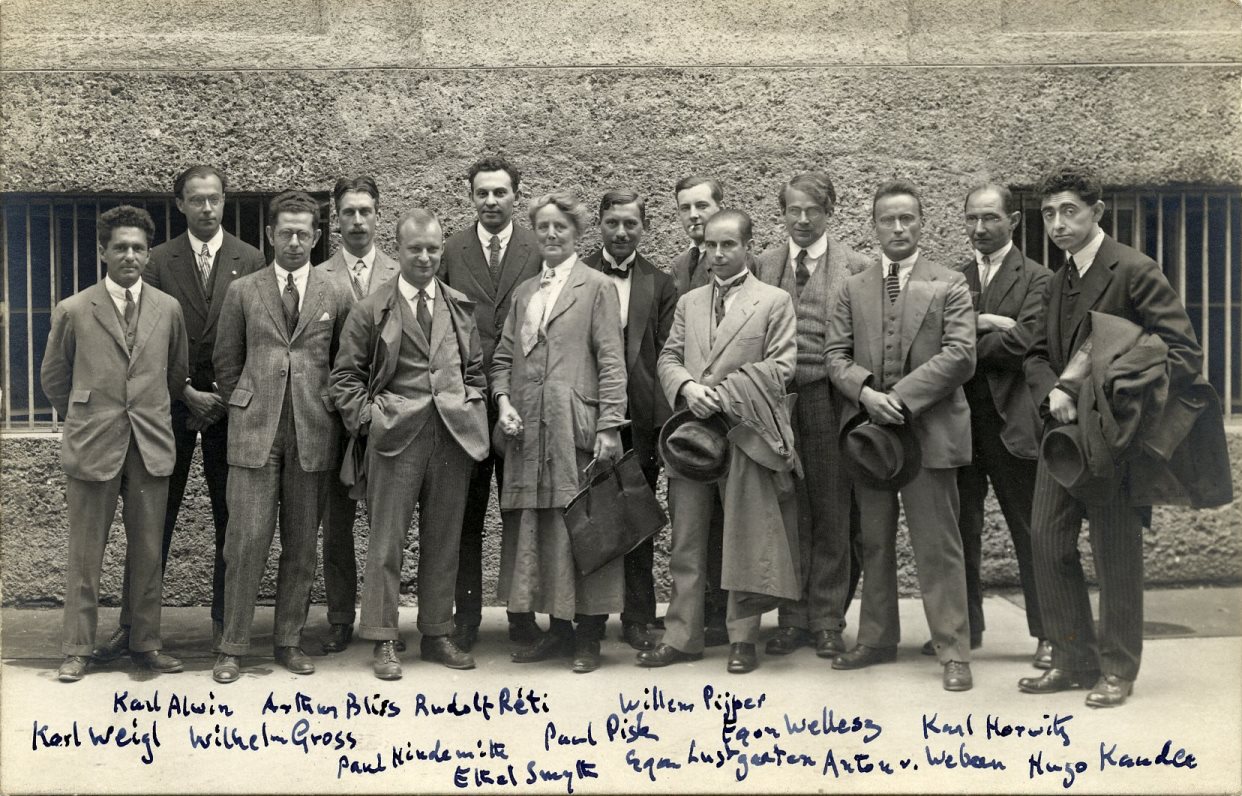
Archive Centre, King’s College – Cambridge – EJD/5/3/1/2
Let’s put the photo in context: two Viennese composers (Rudolf Reti and Egon Wellesz) organized a series of chamber music concerts at the Mozarteum in Salzburg from August 5 to 10, 1922, under the auspices of the International Society for Contemporary Music (ISCM) and under the chairmanship of Richard Strauss, then co-founder of the Salzburg Festival. The goal of this new society was to establish an international peace initiative through music, at a time when the world was just beginning to recover from the First World War (2).
This photo is interesting for understanding the geopolitical context of the time: on the one hand, it shows composers who were on opposing sides during World War I, such as the Englishman Arthur Bliss and the German Paul Hindemith; on the other hand, the brand-new Weimar Republic had just been established, a progressive political regime very open to culture, particularly to the Austro-German musical avant-garde. Many ensembles at the time fiercely championed modern music: the Rosé, Léner, Kolisch, Amar, Budapest, Roth, Busch, and Klinger quartets, among others.
This marked the beginning of a true golden age for the string quartet, which Proquartetto has chronicled in a two-volume reference work (3).
But this era would not last: it was quickly overshadowed by the rise of National Socialism. And our photo reflects a far darker reality, since half of the group gathered around the SIMC would bear the full brunt of Nazi racial laws: Wellesz, Weigl, Grosz, Reti, Lustgarten, Horwitz, and Kauder were indeed forced into exile, while the works of Webern and Hindemith were banned.
(1) Karl WEIGL (8 string quartets), (2) William ALWIN (3 string quartets), (3) Wilhelm GROSZ (1 string quartet), (4) Arthur BLISS (2 string quartets), (5) Paul HINDEMITH (6 quartets), (6) Rudolf RETI (1 quartet), (7) Ethel SMITH (6 quartets), (8) Paul PISK (1 quartet), (9) Willem PIJPER (5 quartets), (10) Egon LUSTGARTEN (0), (11) Egon WELLESZ (9 quartets), (12) Anton WEBERN (6 quartets), (13) Karl HORWITZ (2 quartets), (14) Hugo KAUDER (19 quartets).
(2) The International Society for Contemporary Music (ISCM) has since become one of the most successful organizations in promoting contemporary music.
(3) “The Golden Age of the String Quartet (1920–1933),” in 2 volumes (Part One: Central Europe; Part Two: A Guide to Composers), Proquartetto, “History and Pedagogy” series, 2007.