


As it approaches its 25th anniversary, the Les Voix Intimes festival feels the need to look back on its history. Not out of nostalgia, but to take a retrospective, analytical, and critical look at a program that has been built, season after season, on a delicate balance between musical rigor, fidelity to the repertoire, and a constant focus on the evolution of artistic practices.
With 311 performances of works spanning all seasons, the Les Voix Intimes festival is, above all, deeply committed to the great classical repertoire. This commitment is not merely a stance but the foundation upon which the festival’s reputation and artistic identity have been built.
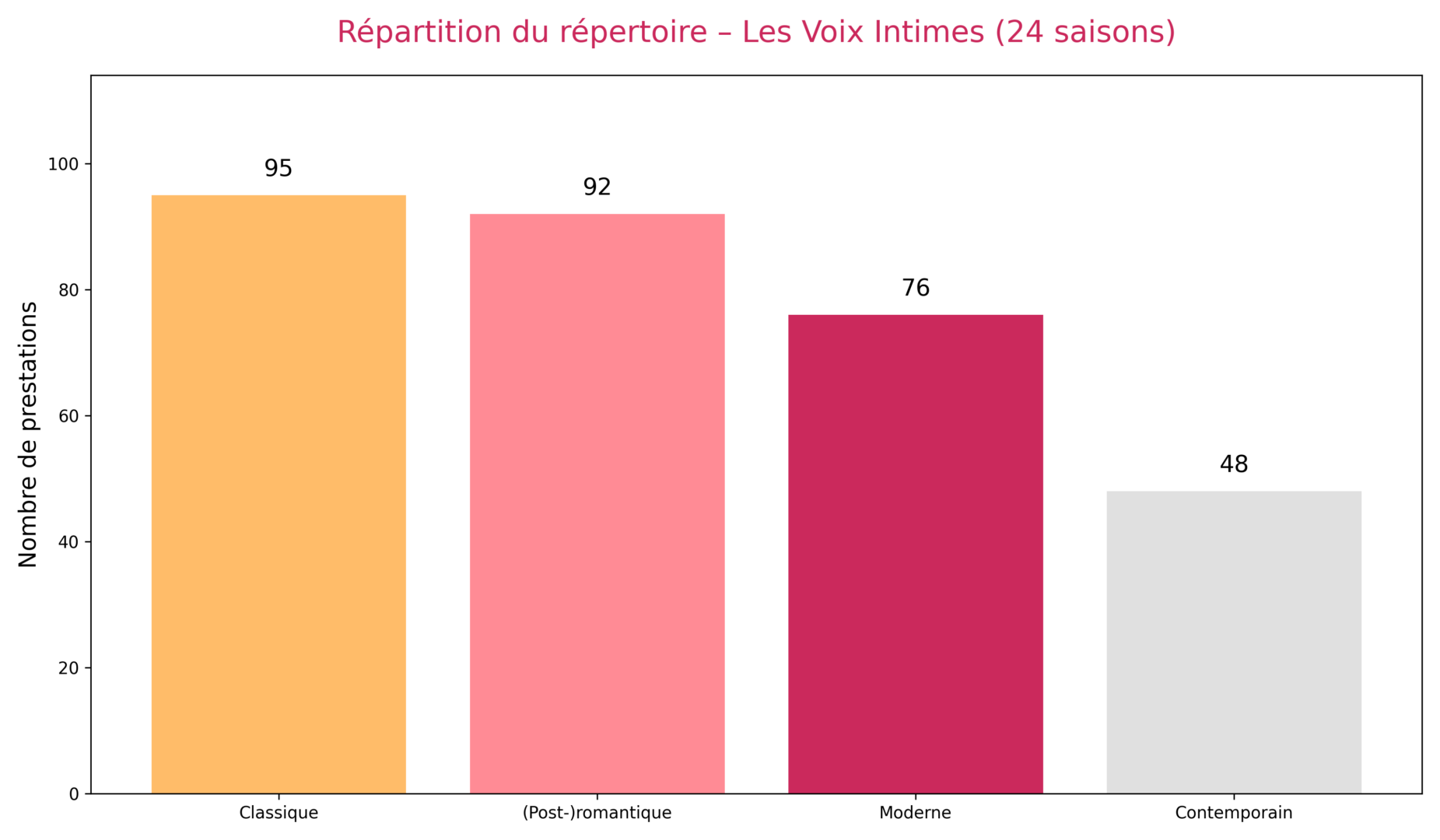
The classical repertoire thus takes center stage with 95 performances, dominated by the genre’s founding figures: Beethoven, Haydn, Mozart, and Schubert, but also composers who are less frequently programmed today, such as Arriaga, Sirmen, and Boccherini. This consistency confirms a lasting commitment to formal structure, balance, and expressive clarity—the historical DNA of the string quartet.
As a natural extension of this legacy, the Romantic and post-Romantic repertoire—viewed here as an aesthetic continuum—comprises 92 performances. From Mendelssohn to Grieg, via Schumann, Brahms, Tchaikovsky, and Dvořák, these major composers helped expand the expressive language of the string quartet. Added to this constellation are pivotal figures (Franck, Chausson, Fauré, Zemlinsky, Nielsen, and Szymanowski), performed more sporadically, who foreshadowed the upheavals of the 20th century.
The modern repertoire (76 performances) also plays a significant role. It paints a particularly rich aesthetic picture, where national traditions intersect with contrasting avant-garde movements: French modernism (Debussy, Ravel, Tailleferre, Milhaud), the Central European schools (Bartók, Janáček, Berg, Webern), the major figures of the 20th century (Stravinsky, Prokofiev, Britten), as well as voices that long remained on the margins of the canon but are now being reevaluated—we’ll come back to that.
Finally, the contemporary repertoire, with 48 performances, plays an increasingly central role in the programming of Les Voix Intimes. Initially a relatively marginal component, its presence has grown significantly over the past decade. Without disrupting the overall balance of the project, this focus reflects the festival’s commitment to broadening its horizons and fostering a dialogue between the heritage and contemporary creation. This commitment has been reflected in particular through a policy of commissioning works (Bacri, Bartholomée, Hus) and the programming of numerous premieres on the Belgian stage (Hosokawa, Widmann, Kellogg, Boisgallais, Grange, Verunelli, etc.): all events that have firmly established Les Voix Intimes in the present moment of music.

Coming up next: