


As it approaches its 25th anniversary, the Les Voix Intimes festival finds it necessary to reflect on its history. This reflection is not born of nostalgia, but rather aims to provide a retrospective, analytical, and critical examination of a program that has been developed season after season. This development has consistently maintained a delicate balance between musical rigor, fidelity to the repertoire, and a keen awareness of evolving artistic practices.
I. An identity rooted in the classical repertoire
II. Leading figures, unflinching loyalty
III. And the Winner Is…
IV. A marked shift in the representation of female composers
Among the 76 performances the festival dedicated to the modern repertoire, a significant number of works refer to a dark chapter in European history: those that the Nazi regime labeled “Entartete Musik” (degenerate music).
As soon as it came to power in 1933, the NSDAP (National Socialist Party) set out to eradicate all forms of avant-garde art in the name of “Aryan racial purity.” As a result, a great many musicians—composers as well as performers (distinguished teachers, members of orchestras or chamber ensembles)—lost their jobs or any means of expressing their talent*.
Leading figures such as Arnold Schoenberg, Alban Berg, and Anton Webern—pioneers of the Second Viennese School—were thus condemned both for their aesthetic radicalism and for strictly ideological and racist reasons. Their works, however, represent one of the most decisive turning points in the musical language of the 20th century.
Alongside them, other brilliant composers (who were also featured in the festival’s program) were directly persecuted, banned, or forced into exile: Erwin Schulhoff, Viktor Ullmann, and Hans Krása, as well as Ernst Toch, Walter Braunfels, Egon Wellesz, Karl Weigl, Pavel Haas, and Erich Wolfgang Korngold.
The programming of these works, which have long been absent from concert halls, is part of an essential effort to preserve our collective memory. It serves as a reminder that European musical modernity did not develop in a linear fashion, but rather through ruptures, imposed silences, and shattered lives.
By performing alongside more established composers (such as Debussy, Ravel, Bartók, and Janáček), Les Voix Intimes help restore the full historical complexity of the modern chamber music repertoire.
This approach is fully in line with the festival’s identity: for nearly a quarter of a century, we have been curating a program that certainly celebrates the “canon,” but also examines its blind spots and the fault lines that run through it.
* For more on this subject, see Amaury du Closel, *The Silenced Voices of the Third Reich*, Paris: Actes Sud, 2005. The book lists more than 200 composers (most of them unknown) who were blacklisted, banned, deported, or even exterminated by the regime.
Coming up: VI. A Focus on Belgian Creativity
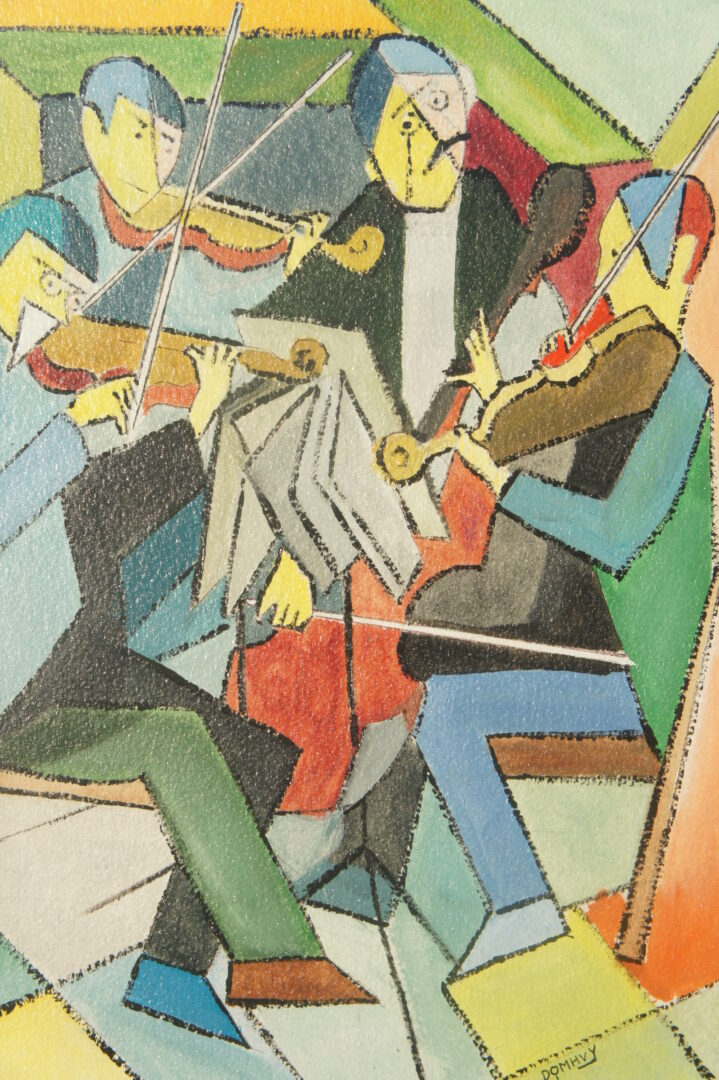
Shown here: Dominique Huybrechts, *The Rosé Quartet* (oil on canvas).