


As it approaches its 25th anniversary, the Les Voix Intimes festival feels the need to look back on its history. Not out of nostalgia, but to take a retrospective, analytical, and critical look at a program that has been built, season after season, on a delicate balance between musical rigor, fidelity to the repertoire, and a constant focus on the evolution of artistic practices.
In our first short article, we discussed the distribution of different types of repertoires across our productions.
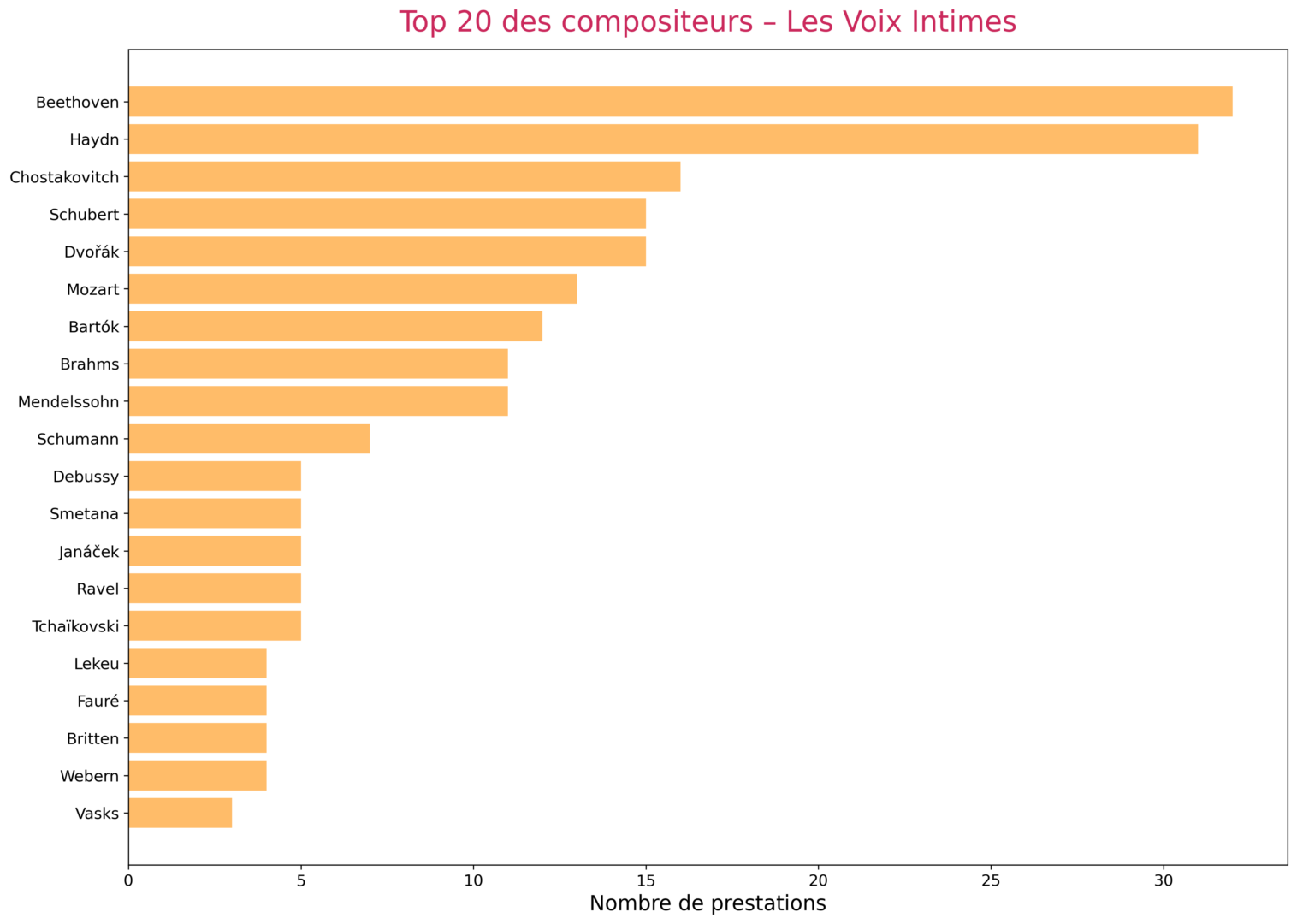
The festival’s history is also reflected in the recurring presence of certain key figures among the 104 composers whose works have been performed. The figures reveal an emotional geography of the repertoire, marked by enduring loyalty and regular returns.
Beethoven and Haydn dominate the list of the most frequently performed composers, confirming their indispensable role in shaping the chamber music repertoire. Alongside them, Schubert, Dvořák, Mozart, Shostakovich, and Bartók play an equally pivotal role.
The prominence of these names fosters not so much a sense of repetition as a spirit of constant reinterpretation. Over the seasons, these composers become the festival’s long-standing partners: their works are revisited and “challenged” by successive generations of performers, within ever-evolving aesthetic contexts.
This commitment to its artistic vision helps forge a distinctive identity: that of a festival that embraces an intimate connection with the core of its repertoire, while avoiding becoming a mere museum piece.
Read also:
Coming up next: